Your agency probably has insurance.
General liability. Workers’ compensation. Maybe professional liability or an umbrella policy.
So if your agency gets hit by a cyberattack, you’re covered… right?
Probably not.
One of the most common gaps we see when working with agencies is a lack of dedicated cyber insurance. And as agencies become increasingly dependent on cloud software, remote teams, online banking, client data, and dozens of connected applications, that’s a significant hole to leave open.
What Exactly Is a “Cyber Event?”
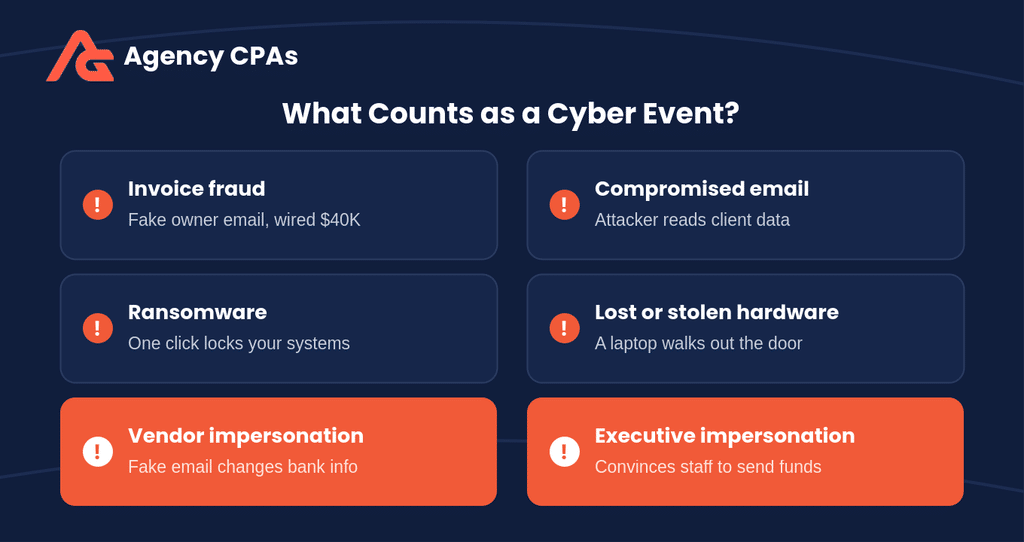
When agency owners hear “cyberattack,” they may picture a sophisticated hacker breaking into a giant corporation. That’s not necessarily what we’re talking about. A cyber event at an agency could be much simpler:
- Invoice fraud. An employee gets what looks like an email from the owner asking them to urgently pay an invoice. They wire $40,000 before realizing it was fraudulent.
- Compromised email. An attacker gets access to sensitive conversations and client information.
- Ransomware. An employee clicks a malicious link, and the agency is locked out of critical systems.
- Lost or stolen hardware. A laptop containing sensitive information walks out the door.
- Client data exposure. An attacker gains access to a client’s information through one of your systems.
- Vendor impersonation. A fraudulent email appears to come from a vendor, and your team changes their banking information.
- Executive impersonation. Someone poses as an agency executive and convinces an employee to send money or sensitive information.
Doesn’t My Regular Business Insurance Cover That?
This is where agency owners can get caught off guard. Most standard business insurance policies aren’t designed to fully cover cyber events. Your general liability policy may protect you against many of the traditional risks of operating a business, but cyber incidents can fall outside that coverage or have significant exclusions and limitations.
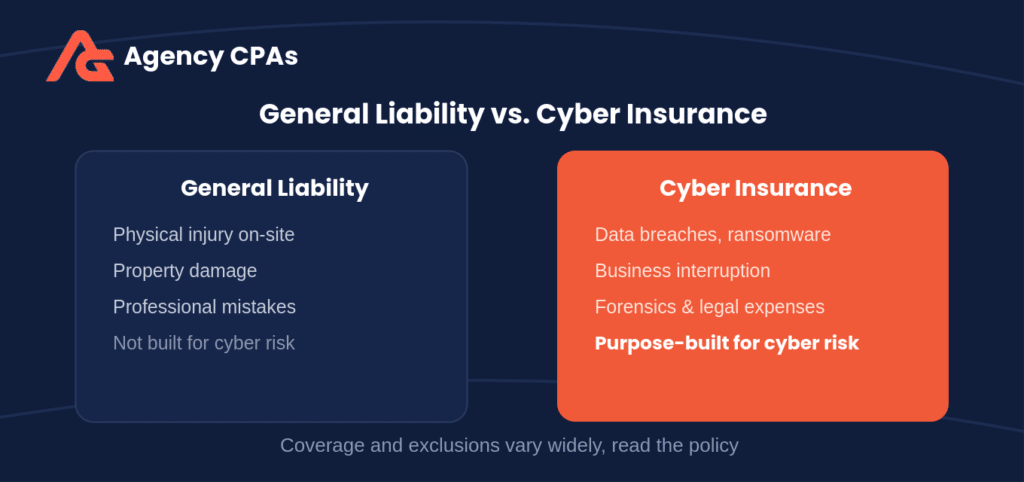
That’s why dedicated cyber insurance has become its own category of business insurance. Depending on the policy, cyber coverage can help with costs associated with data breaches, ransomware, business interruption, forensic investigations, legal expenses, customer notification, data restoration, and certain types of cyber fraud. The details matter tremendously, because cyber policies, and their exclusions, can vary significantly from one insurer to the next.
Why Business Insurance Has Changed
Twenty years ago, an agency’s biggest risks looked different: someone getting injured at the office, an employee making a professional mistake, property damage, a lawsuit. Insurance was built around protecting the physical business.
But agencies have changed. Employees might work from five different states. Files live in the cloud. Teams communicate through email and messaging platforms. Clients pay electronically. And enormous amounts of information can be accessed from a laptop sitting at someone’s kitchen table.
The risks have moved. Insurance has had to move with them. Cyber insurance has gone from a relatively specialized product to an increasingly essential part of protecting a modern agency.
Why Don’t More Agencies Have It?
A few reasons come up again and again:
- Nobody ever told them they needed it. Agency owners aren’t insurance experts. They bought the policies someone recommended when they started the company and kept renewing them. Cyber insurance may never have made the list.
- They assume they’re already covered. As covered above, that assumption is usually wrong.
- The cost. For a smaller policy, premiums often run somewhere in the range of $1,000 to $2,500 a year, and can climb well beyond that depending on revenue, data sensitivity, and security posture.
What Insurers Actually Look At
Buying cyber insurance isn’t as simple as checking a box, and the cheapest policy isn’t necessarily the right one. Insurers care about how seriously your agency takes cybersecurity, and coverage (or a good price on it) usually depends on having the right safeguards in place first:
- Multi-factor authentication
- Regular, tested backups
- Employee security training
- Endpoint protection
- Access controls
What matters most is understanding exactly what risk you’re transferring to the insurer, and what you’re still carrying yourself if something happens.
This Is Something We Check With Our Agencies
We’re a CPA firm. Our core job is helping agency owners make more money, keep more of it, and spend less time dealing with the financial side of the business. That starts with tax strategy. It means getting the financials off the owner’s plate, managing cash flow, planning taxes, and making sure profits efficiently reach the owner’s pocket.
But part of being a financial partner is also looking out for the risks that could undo a lot of that work. Cyber insurance is one of the things we check when we start working with an agency: Do you have it? What does it cover? Are there obvious gaps? We’re not insurance brokers, and we’re not here to sell you a policy. We simply don’t want to see an agency we’ve helped build into a financially strong business stay unnecessarily exposed to a risk that could cause a significant loss.
Common Questions
Does my general liability policy cover a cyberattack? Usually not, or only partially. Most general liability and standard business owner policies weren’t built with cyber risk in mind, and cyber-related claims often fall outside their coverage or run into exclusions.
How much does cyber insurance typically cost? For a smaller agency, a policy in the $1,000–$2,500 per year range is common, though cost depends heavily on revenue, the sensitivity of the data you handle, and the security controls already in place.
What do insurers look for before offering coverage? Common requirements include multi-factor authentication, regular backups, employee security training, endpoint protection, and access controls. Without these, coverage may be denied or offered only at a much higher price.
Is Your Agency Exposed?
Pull out your business insurance policies and look. Do you actually have cyber coverage? If you do, when was the last time you reviewed what it covers? And if you’re assuming your general business insurance would take care of a cyber incident, don’t assume. Ask.
A financially mature agency isn’t just profitable. It has cash in the bank. Taxes are planned for. The financials are under control. And the risks that could seriously hurt the business have been thought through. Make sure cyber is one of them.
Get in touch and we’ll take a look.