From the outside, most successful agencies look polished.
Great website. Great clients. Growing team. Strong portfolio. Plenty of work coming through the door. Everything looks buttoned up.
But what happens when you look under the hood? For a lot of agencies, the answer is duct tape.
The agency might be doing $1 million, $3 million, or $5 million in revenue, but behind the scenes:
- Cash is tighter than it should be.
- Taxes are a constant surprise.
- The owner takes money out of the business whenever the bank account looks healthy.
- Profitability changes from month to month, without a clear understanding of why.
- Tax returns get extended every year.
- There isn’t a clear answer to how much cash the business actually needs.
- The owner finally gets around to looking at the numbers on Saturday morning because they spent the entire week head-down running the agency.
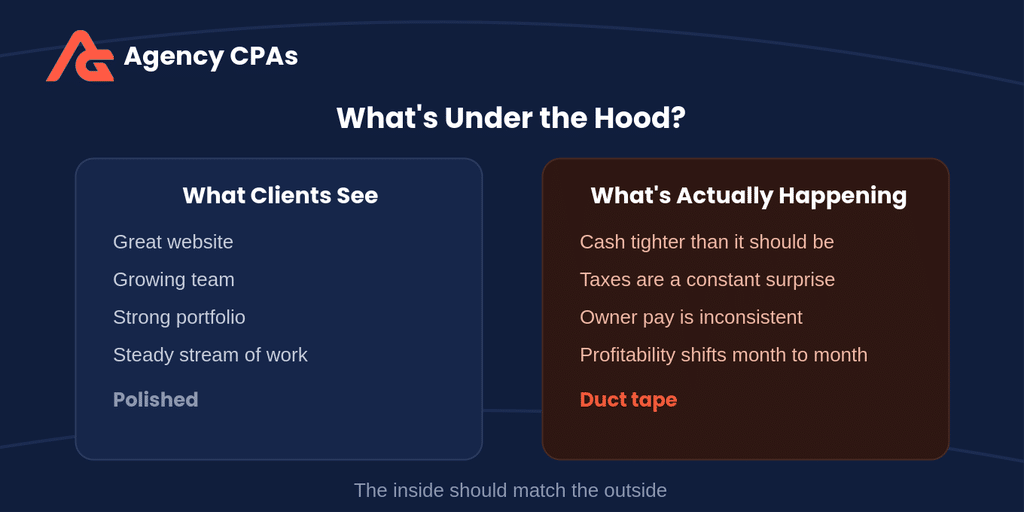
At some point, that has to change. The inside of your agency should match the outside.
What Does a Financially Mature Agency Look Like?
The agencies we work with still have bumps. They lose clients. They make bad hires. They have slow months. They make investments that don’t work out. The difference is that their financial foundation is built to handle those things.
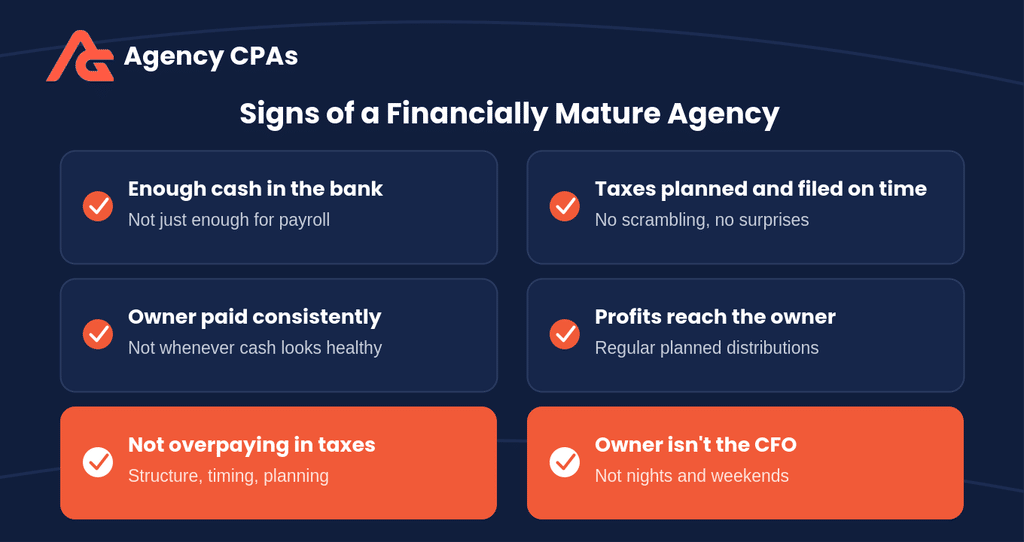
There’s enough cash in the bank.
Not just enough to make payroll next week. A well-run agency maintains a deliberate cash buffer that gives the business room to absorb a lost client, make a strategic hire, invest in growth, or simply weather a few slower months. Growth becomes a lot easier when every decision isn’t dictated by this month’s bank balance.
Taxes are paid and planned for.
There shouldn’t be a scramble every time an estimated tax payment is due. You should have a good idea of what you’re going to owe, money should be set aside for it, and payments should be made throughout the year. April shouldn’t come with a massive surprise.
Tax returns are filed on time.
Tax season shouldn’t be an annual fire drill. When the books are clean throughout the year, tax planning has already happened, and the right information is available, filing the return becomes the final step in a year-long process, not an emergency.
The owner gets paid consistently.
You shouldn’t be transferring money to yourself whenever the checking account happens to look healthy. There should be a plan. Owners should know what they’re getting paid, when they’re getting paid, and how that fits into the agency’s overall cash flow.
Profits actually make it to the owners.
A profitable agency should create wealth for the people who own it. Once the business has the cash it needs to operate and grow, excess profit shouldn’t just accumulate indefinitely in the company bank account. We like to see profits efficiently passed through to owners on a regular basis, often through planned quarterly distributions. The agency keeps what it needs. The owner gets the benefit of what they’ve built.
You’re not paying more tax than you need to.
As an agency grows, tax planning becomes about much more than filing a return. Entity structure, owner compensation, retirement contributions, timing of income and expenses, and dozens of smaller decisions throughout the year can all affect how much ultimately ends up in the owner’s pocket. The goal isn’t simply to pay your taxes. It’s to pay what you owe while taking advantage of the planning opportunities available to you.
The owner isn’t the CFO on nights and weekends.
Agency owners should understand their numbers. They shouldn’t have to live in them. You should know how the agency is performing, where margins are moving, how much cash you have, what you can afford to invest, and what needs your attention. But you shouldn’t have to spend Saturday morning digging through QuickBooks trying to figure it all out. Your financial team should be bringing that information to you.
The Inside Should Match the Outside
This is ultimately about more than clean books or tax returns filed on time. It’s about building an agency that works better for its owner.
- More cash in the bank
- More predictable taxes
- Better decisions
- More profit making its way into your pocket
- Less money unnecessarily going to the government
- Fewer nights and weekends worrying about the numbers
Your clients may already see a polished, successful agency. Your team may see a growing company with a bright future. Your website may make it look like you’ve got everything figured out. Now the financial operation behind the business needs to match.
Common Questions
How do I know if my cash buffer is actually enough? A good starting point is two months of operating expenses, held separately from your day-to-day account. The right number depends on how variable your revenue and client base are.
How often should owner distributions happen? Quarterly is common for agencies once cash flow is predictable enough to plan around. The point is consistency, not a specific frequency, so you’re not just pulling money out whenever the account looks healthy.
What’s the first thing to fix if all of this feels off? Usually cash visibility. Once you know exactly how much cash you have and need, taxes, owner pay, and distributions all become much easier to plan around.
What Does Your Agency Look Like Under the Hood?
If the outside of your agency has outgrown the financial operation behind it, and you’re serious about the next stage of growth, let’s chat.
Get in touch and we’ll take a look.