Your agency is growing. Revenue is up. The income statement shows a profit.
So why does cash still feel tight?
Debt may be part of the answer.
Every month, cash that could fund payroll, hiring, taxes, owner distributions, or a reserve is being sent to a lender. Even when the original loan helped the agency through a difficult period, the payments can continue to limit your options long after that moment has passed.
Getting out of debt is not as simple as deciding to make larger payments. Your agency first needs to produce profit. That profit must cover taxes, working capital, and the cost of growth. Only then can you determine how much cash is truly available for debt repayment.
Without a plan, it’s easy to remain profitable on paper while feeling cash poor for years.
Why Profitable Agencies Still Struggle With Debt
Profit and cash are not the same thing.
Your agency may recognize revenue before a client pays. You may hire a new employee weeks before the work they perform turns into collected cash. You may also owe taxes on profit that has already been used for payroll, debt payments, or owner distributions.
Debt adds another claim on the same pool of cash.
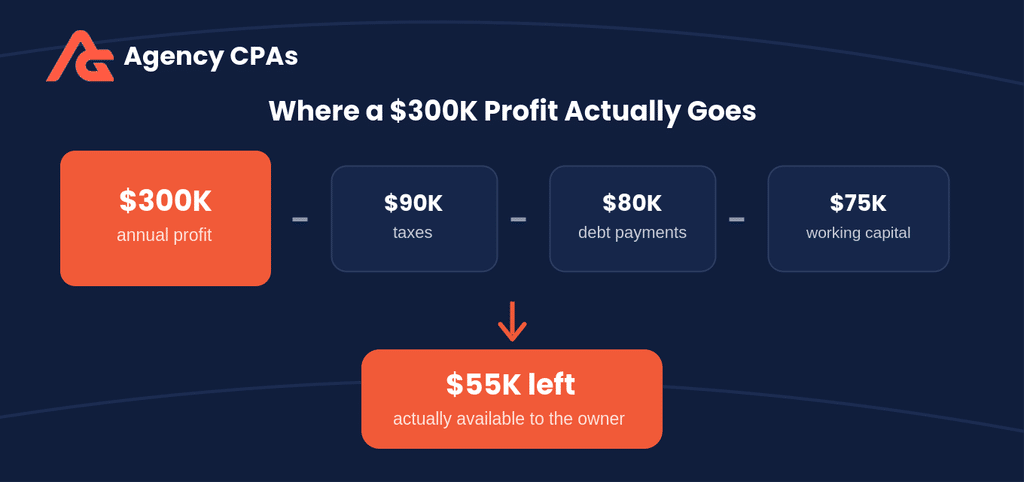
Consider an agency that produces $300,000 in annual profit. That number can sound healthy. But the agency may need $90,000 for taxes, $80,000 for debt payments, and another $75,000 to support hiring and normal cash flow fluctuations.
The remaining cash available to the owner is much smaller than the profit shown on the financial statements. This is why an agency can be growing, profitable, and still feel financially constrained.
Growth Can Make the Problem Worse
Growth does not always produce immediate cash.
As an agency grows, it often needs to hire before new clients pay. Payroll increases immediately, while client cash may not arrive for 30, 45, or even 60 days. Larger projects may require contractors, software, and other costs before the final invoice is collected.
That working capital requirement competes directly with debt repayment.
If you direct every available dollar toward debt, the agency may not have enough cash to hire or deliver new work. If you invest every available dollar in growth, the debt balance may barely move.
The answer is not necessarily to stop growing. It’s to decide how much growth the agency can afford while still making measurable progress on its debt.
You Need Profit Before You Can Pay Off Debt
An agency cannot sustainably borrow its way out of debt.
Before creating a repayment plan, determine whether the core business is consistently profitable. Review pricing, gross margins, utilization, staffing, overhead, and client profitability.
If the agency needs a line of credit every month to make payroll, the immediate issue is probably not the size of the debt payment. The business may be underpriced, overstaffed, collecting too slowly, or carrying more overhead than its revenue can support.
Debt can bridge a temporary timing gap. It cannot permanently solve weak operations. Until the agency produces reliable profit, an aggressive repayment schedule may simply lead to more borrowing later.
Build Your Debt Repayment Plan in the Right Order
A realistic plan should allocate cash in the following order.
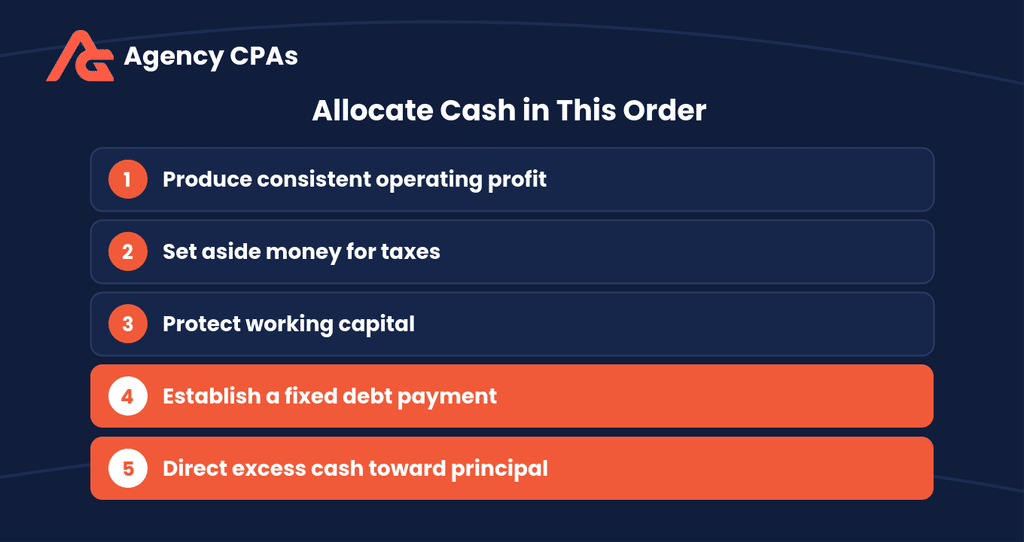
1. Produce consistent operating profit. Start with a business model that generates cash before debt payments. If margins are weak, fix pricing, delivery, utilization, or overhead before committing to an aggressive payoff target.
2. Set aside money for taxes. Tax money is not available cash. Move a percentage of profit into a separate tax account throughout the year so quarterly and annual payments don’t force the agency back onto a credit line.
3. Protect working capital. Maintain enough cash to cover payroll, operating expenses, and normal collection delays. For many agencies, two or three months of operating expenses is a useful starting point, although the appropriate reserve depends on revenue stability and client concentration.
4. Establish a fixed debt payment. Choose a monthly amount the agency can sustain during normal operations. The payment should reduce principal consistently without leaving the business short of cash each month.
5. Direct excess cash toward principal. When cash exceeds the target reserve, use an agreed portion to make additional principal payments. This creates progress without draining the operating account.
Paying Off Debt May Require Owner Patience
There’s an uncomfortable truth in most debt repayment plans: the owner may need to delay taking cash out of the business.
Money cannot simultaneously fund growth, pay taxes, reduce debt, build reserves, and increase owner distributions. Something has to take priority.
That doesn’t mean the owner should stop receiving reasonable compensation. It means distributions beyond that amount may need to remain limited until the agency reaches its cash reserve and debt reduction targets.
The tradeoff should be intentional and temporary. A written plan can define when distributions increase again, such as after the debt falls below a certain amount or the agency maintains its target cash reserve for several consecutive months.
What About a Line of Credit?
Every healthy agency should consider establishing a line of credit while times are good. It can provide a valuable buffer when a profitable client pays late, the agency faces predictable seasonality, or hiring must occur ahead of collections.
But a line of credit should be a tool for timing and growth. It should not become a permanent source of cash for an unprofitable agency.
If the balance isn’t returning to zero periodically, investigate why. Repeated borrowing may indicate that the agency has a structural cash flow problem rather than a temporary gap.
Common Questions
How do I know if my agency has a debt problem or a profitability problem? If you need a line of credit every month just to make payroll, that’s usually a profitability or pricing issue, not a debt size issue. Debt bridges temporary gaps. It doesn’t fix a business that isn’t generating enough margin to cover its own operations.
Should I stop taking owner distributions entirely while paying down debt? Not necessarily. Reasonable compensation should continue. What usually needs to pause is anything beyond that, until the agency hits its cash reserve and debt targets. The key is making that tradeoff intentional and temporary rather than open-ended.
Is a line of credit the same as debt I should be paying down? Not if it’s being used correctly. A line of credit that gets drawn down and returns to zero periodically is a timing tool. One that never returns to zero is behaving like permanent debt, and that’s a signal to look at the underlying cash flow problem it’s masking.
Create a Path Out of Debt
Start by answering five questions:
- Is the agency consistently profitable before debt payments?
- How much cash must be reserved for taxes?
- How much working capital does the agency need to operate and grow?
- What monthly debt payment can the agency sustain without borrowing again?
- How much can the owner reasonably take from the business during the repayment period?
Then build a rolling cash flow forecast that shows expected collections, payroll, taxes, debt payments, hiring, and owner distributions. Review it monthly and adjust the plan before cash becomes an emergency.
Debt doesn’t disappear because revenue is growing. It disappears when the agency consistently produces profit and deliberately assigns part of that cash to repayment.
Is Debt Limiting What You Can Take From Your Agency?
Agency CPAs helps digital agency owners build cash flow plans that balance taxes, debt repayment, owner compensation, and growth. If debt is limiting what you can take from your agency or invest back into it, we can help you create a practical path forward.
Get in touch and we’ll take a look.