Most agency owners running S-Corps are overpaying their taxes
The reason is usually the same: they never set up an accountable plan. It’s one of the most straightforward deductions available to S-Corp owners, and it’s consistently the one we find missing when a new client comes to us.
What an Accountable Plan Is
An accountable plan is an IRS-approved reimbursement arrangement (governed by IRC accountable plan rules under Treas. Reg. §1.62-2) that lets your S-Corp reimburse you for business expenses you incur personally: mileage, home office, phone, equipment. Those reimbursements are deductible for the business and tax-free for you as the owner.
Done wrong, or not done at all, you’re either paying for those expenses out of after-tax dollars, or your bookkeeper is treating the reimbursements as distributions. Either way, you’re leaving money on the table. For most agency owners, the annual savings from a properly structured accountable plan run between $5,000 and $15,000, sometimes more.
Here’s what that looks like in practice:
Say you drive 5,000 business miles a year and have a 200 sq ft home office in a 2,000 sq ft home:
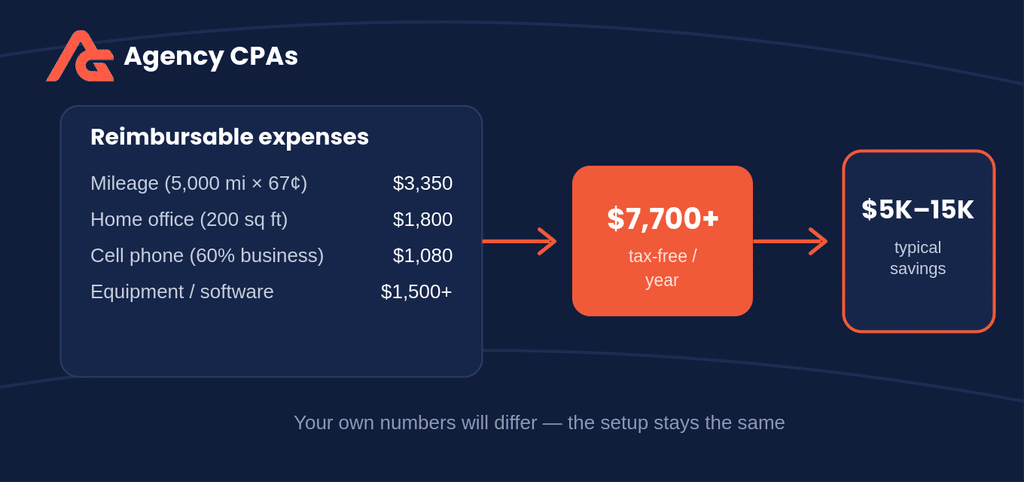
That’s already over $7,700 in tax-free reimbursements – money you’re either forfeiting or mishandling right now if you don’t have a plan in place.
What Qualifies
The IRS has three requirements:
- Expenses must have a legitimate business connection.
- You have to substantiate them: receipts, mileage logs, documentation of business purpose.
- If you receive any reimbursement that exceeds the actual expense, the excess goes back to the company within a reasonable timeframe.
In practice, this isn’t complicated. It just requires a process. Common expenses that work well under an accountable plan include:
- Home office (calculated by square footage)
- Business vehicle use (cents-per-mile or actual costs)
- Cell phone (business-use percentage)
- Equipment or software you bought personally but use for work
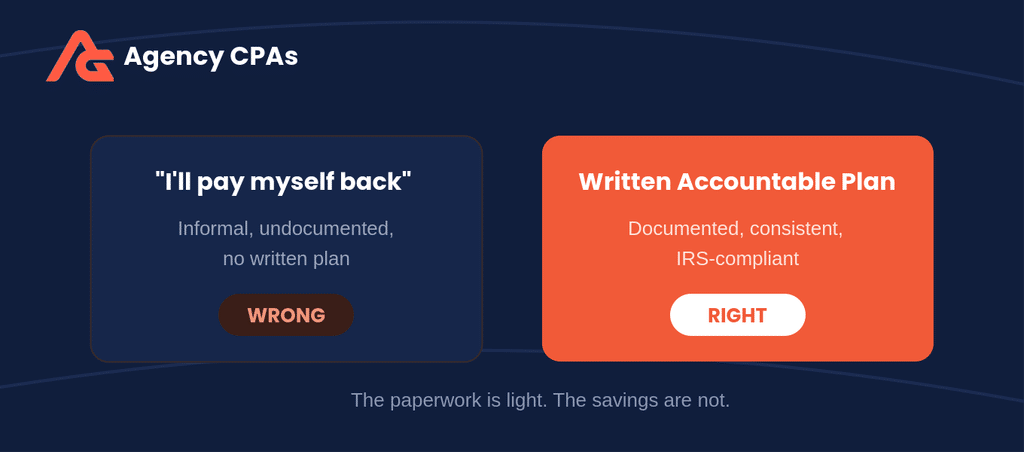
A handshake arrangement or an informal “I’ll pay myself back” doesn’t meet the IRS standard. You need a written plan document and a consistent reimbursement process. The paperwork is light. The savings are not.
How to Set One Up
Keep documentation on file – receipts, mileage logs, and the business purpose for each expense, in case of an IRS inquiry.
Draft a written accountable plan document. This spells out which expense categories are reimbursable and how substantiation works. We can provide a template. No need to build one from scratch.
Choose your reimbursement method for each category (actual cost vs. IRS standard rates, like the mileage rate above).
Set a submission cadence. Monthly or quarterly works well. Don’t let it pile up to year-end.
Route reimbursements correctly in your books. They should post as a business expense reimbursement, not a shareholder distribution.
Why Most Agencies Don’t Have One
Usually it comes down to two things: they didn’t know it existed, or their CPA never brought it up. It doesn’t get flagged unless someone is looking at the full picture of how the business is structured and how the owner is being compensated. It’s exactly the kind of thing that falls through the cracks between “someone who files your taxes” and “someone who’s actively planning your tax strategy.
Setting one up is not a heavy lift. Once it’s in place, it runs on its own. The payoff is real, and it repeats every single year.
Common Questions
Do I need a lawyer to draft the plan document? No. A standard template covers most agencies. We provide one as part of setup, and it just needs to reflect your actual reimbursement categories and process.
Can I set this up mid-year, or does it need to start in January? You can adopt it any time. Reimbursements are only deductible going forward from when the plan is in place, so the sooner it’s set up, the sooner it starts saving you money.
What happens if I get audited and don’t have one? Reimbursements without a qualifying plan can be reclassified as wages or distributions, which changes the tax treatment retroactively. That’s exactly the scenario a written plan and documentation protect you from.
Not Sure If Yours Is Set Up Correctly?
If you already have something resembling an accountable plan, there’s a good chance it’s missing a piece: a written document, the right categories, or proper bookkeeping treatment. We’ll review it in 15 minutes and tell you exactly where the gaps are.
Get in touch and we’ll take a look.